
Latest Articles
- Managing a Company Through the Philosophy of the Human Body: Synergy and Organic Functions in the Custom Rubber Workshop Industry

- Product Certification or Quality Evidence with Client and Third-Party Witness Testing: Which Takes Precedence for a Custom Rubber Spare Part Workshop?

- National Rubber Resilience and Material Innovation: The Heart of Modern Custom Rubber Component Reliability

- Happy Independence Day, Republic of Indonesia!

- Quality Gap Control: Precision Strategies and Risk Management in Customized Rubber Spare Part Manufacturing
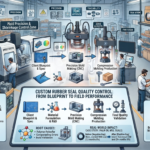
Product Certification or Quality Evidence with Client and Third-Party Witness Testing: Which Takes Precedence for a Custom Rubber Spare Part Workshop?
In the oil and gas industry, equipment safety and reliability are paramount. When managing a workshop that focuses on manufacturing custom rubber spare parts—such as packing elements, seals, or other elastomer components for Blowout Preventer (BOP) systems—critical questions from clients regarding standards and product validity will inevitably arise.
Frequently, procurement teams or client engineering personnel inquire about product certification. However, for workshops handling custom products in limited quantities or specialized orders, possessing mass-manufacturing certifications is uncommon.

Consequently, between formal product certification and quality evidence grounded in witness testing by clients or third parties, which approach holds greater priority and practical reality for a custom rubber spare part workshop?
Product Certification Is an OEM Obligation, Not a Custom Workshop Requirement
The fundamental aspect that must be understood and communicated clearly to clients is the distinct division of roles between mass manufacturers and custom service providers:
- Official Product Certification Belongs to OEMs: Formal certifications like the API Monogram license strictly represent the duty and responsibility of major Original Equipment Manufacturers (OEMs) producing standardized units or components on a mass scale from their production lines.
- Custom Workshops Are Not Required to Issue Product Certifications: Conversely, a custom spare part workshop is not obligated to provide a product certificate due to the specialized nature of its work, which is executed based on old samples, field modifications, or one-off engineering drawings (non-mass production).
Even though workshops are not mandated to hold such product certificates, quality aspects are never disregarded.
Understanding the Position of the API 16A Standard in the Industry
When discussing BOP components, clients frequently reference the API 16A standard (Specification for Drill-Through Equipment). Recognizing the true function of this global standard is essential:
- Not a Guide for Custom Production: API 16A serves as an official manufacturing standard regulating design, pressure ratings, materials, and testing for the mass production of BOP units and their primary components by OEMs. This standard is not a handbook or recipe book for local workshops to manufacture custom parts based on single-run orders.
- As a Technical Reference: Although custom workshops do not hold an API 16A license, the standard functions as a vital technical benchmark. Dimensional tolerances, operational limits, and material class parameters adopted by workshops align with API 16A safety standards to ensure products function safely in the field.
Mandatory Quality Testing: Why Quality Evidence & Witness Testing Take Precedence
Despite lacking a product certification, custom workshops are strictly obligated to conduct quality testing and provide rigorous documentation. For specialized custom rubber components, technical quality evidence and direct witness testing hold far greater priority and reliability among oil and gas engineers.
The rationale is clear:
- Raw Material Traceability and Physical Properties (CoA): Oil and gas clients prioritize the Certificate of Analysis (CoA) or technical data sheet of the rubber compound employed (such as NBR, HNBR, or Viton materials, Shore A hardness levels, and thermal resilience). Actual technical data from raw materials concretely proves material performance.
- Transparent Quality Control (QC Report): Precision dimensional measurement reports utilizing calibrated instruments and visual inspection reports guarantee that products fit accurately within heavy equipment housings.
- Direct Engagement (Witness Testing): For high-risk custom products, opportunities for client teams or Third-Party Inspectors (TPIs) to conduct on-site audits and observe testing phases directly inside the workshop offer far more reassurance than generic administrative certificates.
The Middle Ground: Building Trust Through Technical Evidence
When clients inquire about certification, professional explanations can be delivered by emphasizing industry role boundaries. Formal product certification remains an exclusive obligation of mass-manufacturing OEMs adhering to manufacturing standards like API 16A, whereas workshop operations function as custom solution and independent service providers utilizing those technical parameters as design references.
Instead of product certificates, quality is substantiated through Material Test Reports or Certificates of Analysis from trusted compound suppliers alongside precise internal dimensional inspection reports. Furthermore, welcoming client or third-party representatives to conduct witness testing and direct evaluations inside the workshop during manufacturing establishes an effective pathway for fostering transparency and strengthening long-term trust.
Conclusion
For custom rubber spare part workshops, product certification is not an obligation but rather the domain of OEMs governed by standards like API 16A. Nevertheless, executing quality tests remains strictly mandatory for workshops.
Consequently, quality evidence backed by transparent client and third-party witness testing proves vastly more primary and applicable than rigid formal certifications. Ultimately, oil and gas clients seek functional assurance: confirmation that rubber components are safe, precise, manufactured from correct materials, and proven reliable during field testing.