
Latest Articles
- Managing a Company Through the Philosophy of the Human Body: Synergy and Organic Functions in the Custom Rubber Workshop Industry

- Product Certification or Quality Evidence with Client and Third-Party Witness Testing: Which Takes Precedence for a Custom Rubber Spare Part Workshop?
- National Rubber Resilience and Material Innovation: The Heart of Modern Custom Rubber Component Reliability

- Happy Independence Day, Republic of Indonesia!
- Quality Gap Control: Precision Strategies and Risk Management in Customized Rubber Spare Part Manufacturing
Global Crude Oil Trade and Rubber Consumption 2024-2025: Dependency, Geopolitics, and Sustainability Opportunities
Crude oil remains the backbone of the global economy in 2024, not only as a primary energy source but also as a critical raw material in industries such as synthetic rubber. Meanwhile, the rubber industry, both natural and synthetic, plays a key role in supporting the automotive, infrastructure, and consumer goods sectors. Based on data from the Energy Institute analyzed by Visual Capitalist in the article “Charted: Global Crude Oil Trade Flows in 2024,” as well as various sources related to the rubber industry, this article explores the interplay between global crude oil trade, rubber consumption, and the challenges faced, particularly in Indonesia as one of the world’s largest natural rubber producers. Considering geopolitical dynamics, price fluctuations, and environmental regulations, this article also discusses opportunities to enhance sustainability and competitiveness in the rubber industry.
Global Crude Oil Trade Landscape in 2024
In 2024, global crude oil trade reflects geopolitical tensions and rising energy demands. China remains the world’s largest oil importer, with 11.1 million barrels per day, followed by Europe (9.3 million barrels per day) and the United States (6.6 million barrels per day, with 62% sourced from Canada). Despite Western sanctions due to the war in Ukraine, Russia continues to be a major exporter, with 81% of its exports flowing to China and India. The United States, bolstered by record-breaking shale oil production in 2024, has also emerged as a significant exporter, helping to fill supply gaps in European and Asian markets.
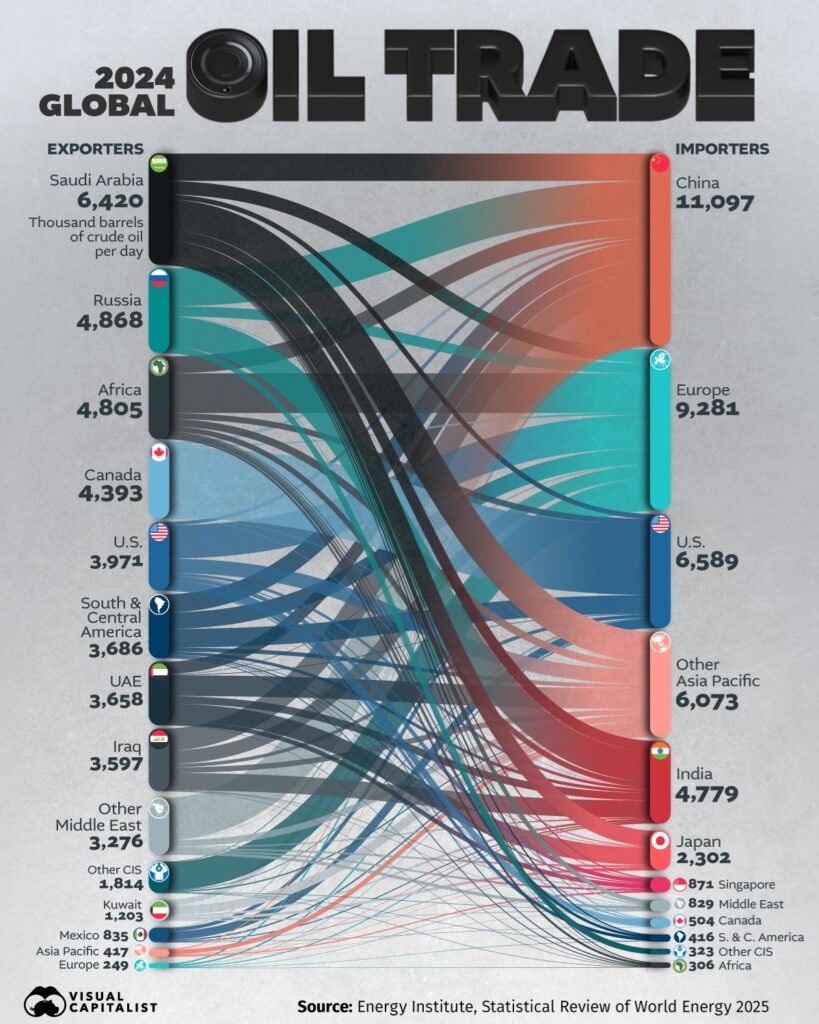
Crude oil is not only used for fuel but also as a raw material for synthetic rubber, which competes with natural rubber in the global market. Fluctuations in oil prices, influenced by sanctions, conflicts, and supply-demand dynamics, directly impact the production costs of synthetic rubber, which in turn affects the demand for natural rubber, including from Indonesia.
Global Rubber Consumption: Trends and Challenges
Global rubber consumption, encompassing both natural and synthetic rubber, continues to grow alongside increasing demand from the tire, medical, and infrastructure sectors. According to The Business Research Company (January 2025), the global rubber market was valued at $400.43 billion in 2024 and is projected to reach $428.95 billion in 2025, with a compound annual growth rate (CAGR) of 7.1%. By 2029, the market is expected to reach $544.5 billion with a CAGR of 6.1%. The tire industry accounts for approximately 60% of global natural rubber consumption, followed by sectors such as medical gloves, footwear, and infrastructure.
However, global rubber consumption faces several challenges in 2024-2025:
- Relationship with Crude Oil Prices:
- Synthetic rubber, made from oil derivatives like butadiene and styrene, is heavily influenced by oil prices. Rising oil prices in 2024, partly due to geopolitical tensions, have increased synthetic rubber costs, boosting demand for natural rubber. Conversely, disruptions in natural rubber supply can increase reliance on synthetic rubber.
- The price of natural rubber TSR 20 reached a five-year high in 2024 but remains volatile and has not stabilized above $2.1 per kg, a level considered profitable for farmers. Projections indicate natural rubber prices will rise to $1.5 per kg in 2025 and $2.5 per kg by 2027.
- Low Domestic Consumption in Indonesia:
- Indonesia, the world’s second-largest natural rubber producer with 3.55 million metric tons in 2024, consumes only 18-20% of its production domestically (approximately 600,000-700,000 tons per year). In comparison, China accounted for 43% of global rubber consumption in 2020, followed by India and the European Union (each at 8%).
- Low domestic consumption in Indonesia hampers local rubber price stability and increases reliance on exports, particularly to China.
- Production Challenges:
- Indonesia’s natural rubber production declined from 3.68 million tons in 2017 to 2.24-2.65 million tons in 2023, due to aging rubber trees, land conversion to palm oil, and the Pestalotiopsis leaf fall disease since 2018, which can reduce productivity by 40-80%. Although its impact lessened in 2024, the disease remains a threat.
- The area of rubber plantations shrank from 3.78 million hectares in 2021 to 3.15 million hectares in 2023, as low rubber prices prompted farmers to switch to other crops.
- Environmental Regulations:
- Starting January 2025, the European Union implements the EU Deforestation-free Regulation (EUDR), requiring geolocation data to ensure rubber products are deforestation-free. With 92% of Indonesia’s rubber production coming from smallholder plantations, compliance with EUDR poses a significant challenge.
- Global demand for sustainable rubber is rising, but Indonesian smallholders struggle to meet these standards due to high production costs and low selling prices.
- Limited Downstream Development:
- Over 80% of Indonesia’s rubber is exported as raw material (SIR 20) rather than value-added products like tires or infrastructure components. The lack of downstream industries limits economic potential and resilience to global market fluctuations.
The Interplay of Crude Oil and Rubber
Fluctuating crude oil prices in 2024, driven by sanctions on Russia and U.S. shale production, impact the rubber market dynamics. Rising oil prices increase synthetic rubber costs, boosting demand for natural rubber, which benefits countries like Indonesia. However, disruptions in natural rubber supply—such as those caused by plant diseases or natural disasters like the 2017 floods in Thailand—can increase reliance on synthetic rubber, depressing natural rubber prices.
China, as the largest oil importer and rubber consumer, is central to these dynamics. Its economic slowdown due to past trade tensions with the U.S. previously suppressed global rubber demand, but 2025 projections indicate recovery driven by the tire and infrastructure sectors.
Strategies for Indonesia
To address low domestic consumption and production challenges, Indonesia has proposed several strategies:
- Downstream Development and Innovative Products:
- Developing products like rubberized asphalt, earthquake-resistant bearings, and railway track pads could increase domestic consumption by 100,000-120,000 tons annually. Rubberized asphalt, for instance, offers 50% longer durability at only 15-20% higher cost per m².
- The Ministry of Industry is promoting non-conventional products like dock fenders and retreaded tires to reduce reliance on raw material exports.
- Plantation Rejuvenation:
- Rejuvenation programs for smallholder rubber plantations using superior clones and agroforestry models aim to boost productivity. In 2018, the Ministry of Agriculture targeted rejuvenating 700,000 hectares by 2020, though funding challenges persist.
- Strengthening Farmer Institutions:
- Rubber Processing and Marketing Units (UPPB) improve the quality of processed rubber and increase farmers’ selling prices by 10-15%. In 2023, over 450 UPPBs managed 15% of national production, supporting compliance with regulations like EUDR.
- Regional Cooperation:
- Through the International Tripartite Rubber Council (ITRC) with Thailand, Malaysia, and Vietnam, Indonesia aims to increase domestic consumption by at least 10% for infrastructure and advocate for more stable rubber prices.
- Carbon Trading:
- With over 3 million hectares of rubber plantations, Indonesia has the potential to sequester over 100 million tons of CO2 annually. Carbon trading could provide additional income for farmers, reducing dependence on global rubber prices.
Implications for Indonesia
As the world’s second-largest natural rubber producer, Indonesia faces structural challenges such as declining production, shrinking plantation areas, and low domestic consumption. However, projected price increases from $1.5 per kg in 2025 to $2.5 per kg in 2027, along with global rubber market growth, offer opportunities for industry revitalization. Strategies like downstream development, plantation rejuvenation, and compliance with environmental regulations like EUDR can enhance Indonesia’s competitiveness in the global market.
Conclusion
Global crude oil trade and rubber consumption in 2024-2025 are interconnected through price dynamics, supply chains, and industrial needs. Crude oil, as a raw material for synthetic rubber, influences natural rubber demand, while challenges like plant diseases, environmental regulations, and limited downstream development constrain Indonesia’s potential. With the right strategies, such as innovative product development and plantation rejuvenation, Indonesia can boost domestic consumption, reduce export dependency, and strengthen its position in the global market. As the global energy transition progresses, crude oil and rubber remain economic pillars, with significant opportunities for sustainable growth if these challenges are addressed effectively.