
Latest Articles
- CDM Rubber: Engineered Rubber Solutions for Oil & Gas and Heavy Industries
- Managing a Company Through the Philosophy of the Human Body: Synergy and Organic Functions in the Custom Rubber Workshop Industry
- Product Certification or Quality Evidence with Client and Third-Party Witness Testing: Which Takes Precedence for a Custom Rubber Spare Part Workshop?
- National Rubber Resilience and Material Innovation: The Heart of Modern Custom Rubber Component Reliability

- Happy Independence Day, Republic of Indonesia!
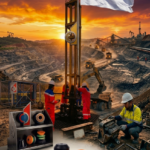
Strategic Partner for the Oil & Gas and Heavy Industries: The Excellence of CDM Rubber’s Engineered Solutions
In today’s increasingly demanding industrial environment, operational reliability, equipment durability, and production efficiency are essential to maintaining business continuity. Industries such as oil and gas, mining, smelting, automotive manufacturing, petrochemicals, and maritime operations rely on machinery and equipment that must perform consistently under extreme operating conditions.
Every component, regardless of its size, contributes to the overall reliability of an industrial system. Sealing elements, gaskets, packers, and protective rubber components play critical roles in maintaining pressure integrity, preventing fluid leakage, absorbing mechanical impact, and protecting valuable equipment.
Even a minor failure in these components can result in unplanned downtime, significant financial losses, operational disruptions, and potential safety and environmental consequences.
Addressing these challenges requires more than simply supplying replacement parts. It requires engineering expertise, material knowledge, manufacturing precision, and a thorough understanding of actual operating conditions.
This is where CDM Rubber positions itself as a strategic engineering and manufacturing partner for the oil and gas and heavy industries.
With a commitment to engineered rubber solutions for extreme performance, CDM Rubber develops and manufactures customized rubber, rubber-to-metal bonded, and industrial sealing components designed to meet demanding application requirements, including high hydraulic pressure, extreme temperature variations, severe abrasion, and exposure to aggressive chemicals and industrial fluids.
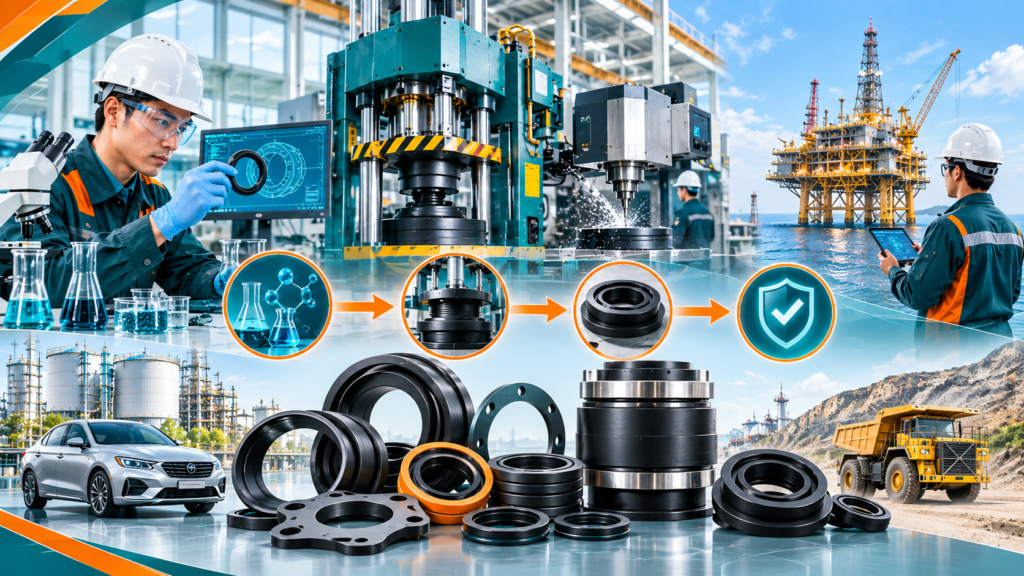
Through an integrated approach combining material research, precision manufacturing, quality assurance, and field engineering support, CDM Rubber aims to strengthen equipment reliability and support the long-term operational performance of its industrial customers.
1. The Integrated Engineering Workflow: From Concept to Field Performance
In precision manufacturing, product quality should never depend on chance or isolated inspection activities. It must be established through a controlled and interconnected engineering process.
CDM Rubber implements an Integrated Workflow that connects every stage of product development and manufacturing, beginning with polymer research and compound formulation, followed by mold engineering, precision production, quality verification, and field performance evaluation.
The purpose of this integrated system is to ensure that every component is developed according to its intended application, material requirements, dimensional specifications, and operating conditions.
Rather than treating each department as an independent function, CDM Rubber emphasizes collaboration between engineering, research and development, production, and quality assurance teams.
This interconnected approach helps identify potential problems at an early stage, reduce manufacturing inconsistencies, and establish a systematic foundation for continuous improvement.
The ultimate objective is to achieve consistent product quality, minimize component failure risks, and support zero-defect manufacturing targets.
2. Three Main Stages of the Integrated Spare Part Lifecycle & Quality Workflow
CDM Rubber’s manufacturing philosophy is implemented through three interconnected stages. Each stage has a specific function in ensuring product reliability, from initial material development to actual field performance.
Stage 1: Compound & Mold R&D
Research, Formulation, and Mold Engineering
The foundation of a reliable engineered rubber component begins with selecting the appropriate polymer and developing a compound formulation that matches the intended operating environment.
At this stage, CDM Rubber conducts several essential engineering activities.
Polymer Selection
The engineering team evaluates the customer’s operating conditions to determine the most suitable base polymer. Material selection considers temperature exposure, chemical compatibility, mechanical loading, pressure requirements, and expected service conditions.
Available polymer families include:
- HNBR (Hydrogenated Nitrile Butadiene Rubber)
- NBR (Nitrile Butadiene Rubber)
- EPDM (Ethylene Propylene Diene Monomer)
- FKM (Fluoroelastomer, commonly known by the trade name Viton)
- CR (Chloroprene Rubber)
- Silicone Rubber
Rheometer & Hardness Testing
Rubber compounds are evaluated through rheometer testing to determine vulcanization characteristics, including curing behavior and processing parameters.
Hardness testing is also conducted to verify that the compound meets the specified Shore A requirements.
These evaluations help establish appropriate processing conditions before the material enters the production stage.
3D CAD/CAM Mold Engineering
Computer-aided design and manufacturing technologies are utilized to develop precision molds based on product geometry, dimensional requirements, and manufacturing considerations.
Accurate mold engineering is essential for achieving dimensional consistency, minimizing defects, and ensuring repeatable production results.
Prototype Compounding
Initial compound formulations and prototype samples are developed to evaluate their physical and mechanical characteristics.
Depending on application requirements, evaluations may include hardness, tensile strength, elongation, compression set, chemical compatibility, and thermal resistance.
This process provides an important technical foundation before proceeding to production qualification.
Stage 2: Precision Manufacturing
High-Precision Manufacturing
Following material formulation and mold preparation, the process moves into the manufacturing workshop.
At this stage, CDM Rubber combines controlled vulcanization processes, specialized bonding techniques, precision machining, and dimensional inspections.
High-Pressure Hydraulic Vulcanization
Hydraulic molding machines are used to apply controlled heat, pressure, and curing time to transform the rubber compound into its final product geometry.
The vulcanization process establishes the cross-linked molecular structure responsible for the material’s mechanical properties, elasticity, and resistance characteristics.
Proper control of these parameters is essential for achieving consistent product quality.
Precision Rubber-to-Metal Bonding
For components requiring integrated rubber and metal structures, specialized bonding systems and surface preparation techniques are applied.
The process is designed to establish strong adhesion between rubber compounds and metal substrates, allowing the finished components to withstand mechanical loads, vibration, and operational stresses.
CNC Machining & Precision Trimming
Machining and trimming processes are performed to remove excess material, refine product geometry, and achieve the required dimensional specifications.
Depending on product design and manufacturing requirements, CNC machining and other precision finishing methods are utilized.
In-Line Dimensional Verification
Dimensional inspections are conducted throughout the manufacturing process to identify deviations at an early stage.
Critical dimensions are checked against approved drawings, technical specifications, and customer requirements.
This ensures greater consistency and reduces the risk of non-conforming products reaching the final inspection stage.
Stage 3: Field Deployment & Quality Assurance
Field Deployment and Performance Validation
Manufacturing quality does not end when a product leaves the workshop.
The final stage focuses on product verification, technical documentation, installation support, and the evaluation of actual operating performance.
Pressure & Tensile Laboratory Testing
Finished products are subjected to appropriate physical and mechanical testing according to their intended application and agreed technical specifications.
Depending on product requirements, testing may include tensile strength, elongation, hardness, compression set, dimensional verification, and pressure-related performance evaluation.
Pressure testing must be performed using suitable equipment and defined test procedures, where applicable.
API 16A Technical Reference
For products intended for upstream oil and gas applications, CDM Rubber uses relevant API 16A technical requirements and engineering practices as references when applicable to the specific product and customer requirements.
These references help guide engineering considerations, material selection, dimensional requirements, and product evaluation.
It is important to clarify that CDM Rubber operates as a specialized custom rubber manufacturing partner and does not claim to hold API 16A product or facility certification.
The applicable certification and compliance requirements for the complete equipment assembly remain subject to the equipment manufacturer’s specifications, system design, and the operator’s regulatory obligations.
On-Site Installation Assistance
Where required, CDM Rubber can provide technical assistance during installation at the customer’s operational site.
This support helps ensure that components are handled and installed according to the applicable technical requirements and installation procedures.
Performance Tracking & MTBF Review
Product performance can be evaluated through customer feedback, operational observations, and failure analysis.
Mean Time Between Failures (MTBF) data, where available, can provide valuable insights into component reliability and opportunities for improvement.
These findings become part of the continuous improvement process for future product development and manufacturing optimization.
3. Strategic Support Services: Field Operation Engineering
CDM Rubber’s engineering philosophy extends beyond the manufacturing of physical components.
Recognizing that industrial reliability depends on both product quality and correct field application, CDM Rubber incorporates Field Operation Engineering as an important part of its technical support capabilities.
This approach reflects a broader commitment to providing engineering solutions rather than simply supplying replacement parts.
The Field Operation Engineering function focuses on two primary areas.
1. Field Engineering Support
Technical assistance is provided to help customers identify operational challenges, evaluate component-related problems, and determine appropriate engineering solutions.
Activities may include:
- Technical inspection and troubleshooting.
- Component failure assessment.
- Replacement part identification.
- Dimensional verification.
- Material and compound recommendations.
- Installation-related technical assistance.
2. On-Site Wellhead Equipment Verification
For upstream oil and gas applications, wellhead equipment requires particular attention to sealing integrity and dimensional compatibility.
Technical verification activities may include inspection of sealing interfaces, dimensional checks, identification of existing components, and assessment of replacement seal and packer requirements.
These activities help customers establish greater confidence in component selection and installation compatibility.
Through direct technical engagement, CDM Rubber seeks to minimize installation-related problems, improve component reliability, and support the longer service life of critical industrial assets.
4. Elastomer Compound Specification Matrix
The performance of an engineered rubber component depends heavily on the selection of the appropriate elastomer.
Different industrial environments create different material challenges. Some applications require resistance to petroleum-based fluids, while others demand protection against steam, aggressive chemicals, high temperatures, or severe mechanical wear.
To address these requirements, CDM Rubber works with several elastomer families suitable for different industrial applications.
The following matrix provides indicative material characteristics. Actual operating limits depend on compound formulation, fluid composition, pressure, exposure duration, and application-specific qualification.
| Polymer Grade | Indicative Temperature Range | Primary Chemical & Fluid Suitability | Typical Applications |
|---|---|---|---|
| HNBR | -30°C to +160°C | Petroleum oils, selected hydrocarbon fluids, H₂S and CO₂ environments subject to compound qualification | BOP Ram Packers, Wellhead Seals |
| NBR | -20°C to +120°C | Petroleum oils, lubricants, hydraulic fluids | Stuffing Box Seals, Oil Savers |
| EPDM | -40°C to +150°C | Steam, hot water, weathering, ozone | Automotive Cushion Sets, Steam Seals |
| CR (Neoprene) | -40°C to +120°C | Weathering, ozone, selected oils and industrial environments | Marine Fenders, Industrial Gaskets |
| Silicone | -40°C to +200°C | Hot air, weathering, ozone, selected chemical environments | High-Temperature Gaskets, Specialized Seals |
| FKM (Viton) | Compound-dependent, commonly up to approximately +200°C | Many hydrocarbons, oils, fuels, and selected aggressive chemicals | Chemical Seals, High-Temperature Oil Seals |
Understanding the Characteristics of Different Elastomer Materials
HNBR – Hydrogenated Nitrile Butadiene Rubber
HNBR is an important elastomer for demanding oil and gas applications.
Its hydrogenated polymer structure provides improved thermal stability, mechanical strength, and resistance to aging compared with conventional NBR.
Depending on the formulation, HNBR can provide resistance to petroleum-based fluids, elevated temperatures, and selected H₂S and CO₂ environments.
It is commonly considered for BOP Ram Packers, Wellhead Seals, and other critical sealing components.
For sour-service applications, material qualification must consider the actual H₂S concentration, temperature, pressure, fluid composition, and applicable sour-service requirements.
NBR – Nitrile Butadiene Rubber
NBR is widely used in industrial applications requiring resistance to petroleum-based oils, lubricants, and hydraulic fluids.
Its combination of mechanical properties, oil resistance, and manufacturing flexibility makes it a practical material for many general industrial sealing applications.
Typical applications include Stuffing Box Seals, Oil Savers, hydraulic seals, and industrial gaskets.
EPDM – Ethylene Propylene Diene Monomer
EPDM offers excellent resistance to weathering, ozone, water, and many steam-related environments when properly formulated.
It is particularly suitable for applications where resistance to atmospheric exposure and hot water is important.
EPDM is widely used in automotive rubber components, cushion systems, water seals, and selected steam applications.
However, conventional EPDM is generally unsuitable for petroleum-based oils and hydrocarbon fuels.
CR – Chloroprene Rubber (Neoprene)
CR provides a balanced combination of mechanical strength, weather resistance, ozone resistance, and flexibility.
Its properties make it suitable for marine environments, protective rubber components, industrial gaskets, and selected vibration-control applications.
Silicone Rubber
Silicone is recognized for its broad temperature flexibility and resistance to environmental aging.
It is commonly considered for high-temperature sealing applications, electrical insulation, and specialized industrial components.
Its relatively different mechanical and abrasion characteristics compared with conventional engineering elastomers must be considered during material selection.
FKM – Fluoroelastomer
FKM is particularly valuable in applications involving elevated temperatures, petroleum-based fluids, fuels, and many aggressive chemical environments.
Depending on the grade and formulation, FKM can provide excellent resistance to oils and hydrocarbon-related degradation.
It is commonly used in demanding sealing applications across oil and gas, petrochemical, and industrial processing facilities.
5. The Strategic Position of Custom Workshops and Industrial Compliance
In heavy industries, component reliability must be supported by appropriate technical specifications, manufacturing controls, and equipment compatibility.
However, it is equally important to understand the distinction between a component manufacturer’s responsibilities and the certification requirements of the complete equipment system.
CDM Rubber positions itself as a specialized custom rubber engineering and manufacturing partner.
The company’s role is to develop and manufacture rubber components according to approved technical drawings, material specifications, customer requirements, and relevant industry engineering references.
For upstream oil and gas applications, API 16A may serve as an important technical reference where applicable to the intended product and equipment.
However, the use of an industry standard as an engineering reference must not be confused with holding formal certification under that standard.
CDM Rubber does not independently claim API 16A certification.
Instead, its focus is on manufacturing precision, material suitability, dimensional accuracy, process control, and technical collaboration with equipment manufacturers and operators.
This approach offers several strategic advantages.
1. Application-Specific Engineering Compatibility
Customers can work directly with CDM Rubber to develop replacement components based on actual equipment requirements, approved drawings, dimensional specifications, and selected material grades.
This is particularly important for custom rubber components that may not be readily available through conventional spare-part distribution channels.
2. Domestic Manufacturing and Supply Chain Efficiency
Custom manufacturing capabilities can provide an alternative to dependence on imported replacement components.
Local production may help reduce procurement lead times, improve technical communication, and provide greater flexibility for application-specific modifications.
The actual cost and delivery advantages depend on product complexity, material availability, production volume, and qualification requirements.
3. Clear Technical and Compliance Responsibilities
CDM Rubber emphasizes transparency in defining manufacturing responsibilities and customer compliance requirements.
Product specifications, inspection records, material documentation, and applicable testing results can support the customer’s equipment maintenance and qualification processes.
The final determination of equipment certification and operational compliance remains with the responsible equipment manufacturer, system integrator, and operating organization.
This clear division of responsibilities supports a more professional and technically accountable industrial partnership.
6. Quality Assurance, Technical Integrity & Manufacturing Standards
Consistent manufacturing quality requires more than visual inspection.
It depends on controlled production processes, appropriate testing procedures, technical documentation, and a commitment to continuous improvement.
CDM Rubber’s quality approach incorporates relevant quality management practices and applicable product standards.
Its quality and manufacturing framework includes:
- ISO 9001:2015 Quality Management System.
- SNI 7655:2010 for applicable LPG cylinder valve rubber seals.
- API 16A technical references for relevant upstream oil and gas applications.
- TKDN documentation for applicable products, including certified products exceeding 60% where supported by the relevant certificates.
- Product-specific inspection and testing procedures.
- Dimensional and material verification.
- Continuous improvement through customer feedback and technical evaluation.
These references and qualifications must be understood according to their respective scopes. Not every standard applies to every product, and product-specific certification claims should always be supported by valid documentation.
Through disciplined quality management, CDM Rubber seeks to maintain manufacturing consistency while supporting customers’ technical and operational requirements.
7. Commitment to Sustainability and the Future of Engineered Rubber
Industrial sustainability is increasingly connected to equipment reliability, resource efficiency, workplace safety, and responsible manufacturing.
Premature component failure can contribute to unnecessary material consumption, production interruptions, maintenance costs, and industrial waste.
By developing durable replacement components and supporting proper material selection, CDM Rubber seeks to contribute to more efficient industrial operations.
The company’s long-term development focuses on several strategic priorities:
Continuous Polymer Research and Development
Improving compound formulations to meet increasingly demanding operating environments, including high-temperature applications, aggressive chemical exposure, and severe mechanical loading.
Precision Manufacturing Development
Strengthening manufacturing capabilities through improved production technology, mold engineering, process control, and quality verification.
Domestic Industrial Supply Chain Development
Supporting local manufacturing capabilities and providing alternative sources for selected industrial rubber components that have traditionally depended on imported supplies.
Field Engineering Integration
Expanding technical support capabilities to connect manufacturing knowledge with actual equipment operating conditions.
Operational Reliability and Environmental Responsibility
Promoting component reliability, efficient resource utilization, and responsible manufacturing practices.
Through these initiatives, CDM Rubber aims to strengthen its position as a national engineering and manufacturing partner capable of serving increasingly complex industrial requirements.
8. Conclusion: Engineering Reliability Beyond Replacement Parts
The implementation of an Integrated Workflow demonstrates that high-quality engineered rubber components are not simply the result of advanced machinery or selected raw materials.
They are the outcome of a systematic engineering process that connects material research, compound formulation, mold engineering, precision manufacturing, quality assurance, and field performance evaluation.
By combining polymer expertise, hydraulic vulcanization capabilities, rubber-to-metal bonding technology, precision manufacturing, and field engineering support, CDM Rubber provides a comprehensive approach to industrial rubber component development.
From HNBR sealing components for oil and gas applications to NBR industrial seals, EPDM automotive components, and specialized rubber products for mining, smelting, and maritime industries, each solution begins with understanding the actual application requirements.
CDM Rubber believes that industrial reliability should be engineered from the beginning, not merely evaluated after a component fails.
With a commitment to technical integrity, manufacturing precision, continuous improvement, and customer collaboration, CDM Rubber continues to develop its capabilities as a strategic engineering and solution partner for Indonesia’s heavy industries and beyond.
CDM Rubber – Your Engineering & Solution Partner.
Engineered Rubber Solutions for Extreme Performance.
For more information about product capabilities, technical specifications, custom manufacturing, and engineering partnerships, visit:
Website: https://www.cdm-rubber.com
CDM Rubber
Your Engineering & Solution Partner