
Latest Articles
- Managing a Company Through the Philosophy of the Human Body: Synergy and Organic Functions in the Custom Rubber Workshop Industry
- Product Certification or Quality Evidence with Client and Third-Party Witness Testing: Which Takes Precedence for a Custom Rubber Spare Part Workshop?

- National Rubber Resilience and Material Innovation: The Heart of Modern Custom Rubber Component Reliability

- Happy Independence Day, Republic of Indonesia!

- Quality Gap Control: Precision Strategies and Risk Management in Customized Rubber Spare Part Manufacturing
Managing a Company Through the Philosophy of the Human Body: Synergy and Organic Functions in the Custom Rubber Workshop Industry
Introduction
A manufacturing company is often perceived as a collection of machines, production facilities, human resources, and organizational structures. However, a closer examination reveals that a company is far more complex. It is a living system consisting of interconnected functions that depend on one another and work together to achieve a common purpose.
The human body provides a compelling analogy for understanding this concept.
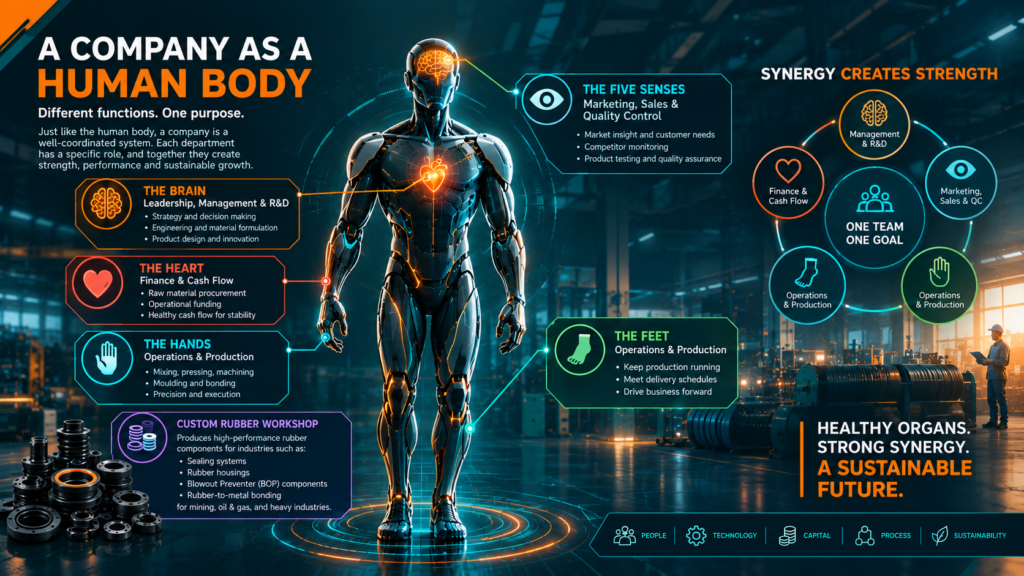
The human body consists of various organs, each with its own specialized function. The brain controls and coordinates activities, the heart circulates blood and nutrients, the sensory organs gather information from the surrounding environment, while the hands and feet execute physical activities. No single organ can sustain life independently. The body’s health and performance depend on the harmonious interaction of all its organs.
The same philosophy applies to a custom rubber workshop.
Unlike mass-production facilities that manufacture standardized products in large quantities, a custom rubber workshop deals with a wide variety of materials, designs, dimensions, and demanding technical requirements. Its products may include sealing systems, rubber housings, Blowout Preventer (BOP) components, and rubber-to-metal bonded products for mining, oil and gas, and other heavy industries.
In this environment, success cannot be determined solely by advanced machinery or skilled operators. It requires the integration of technical knowledge, production capabilities, financial management, marketing, quality control, and leadership.
A company must function as one unified organism.
- Every Department Is an Organ with a Specific Function
In the human body, every organ has a unique structure and specialized function. The brain cannot replace the heart, just as the heart cannot take over the functions of the lungs. Each organ must perform its role effectively.
The same principle applies to a custom rubber workshop.
A. The Brain: Leadership, Management, and Research & Development
The brain is the central control system that receives information, analyzes situations, determines direction, and coordinates the body’s activities.
Within a company, this function is represented by the leadership team, management, engineering, Research & Development (R&D), and material formulation specialists.
They are responsible for understanding customer requirements, translating technical specifications into product designs and manufacturing processes, and determining the company’s strategic direction.
For example, when receiving an order for rubber components intended for high-pressure environments, extreme temperatures, or aggressive chemical exposure, the engineering team must determine the appropriate material, whether Natural Rubber, NBR, HNBR, or Fluoroelastomer.
Such decisions must consider material characteristics, operating conditions, manufacturing capabilities, cost efficiency, and quality requirements.
An effective brain does not merely think and plan. It also provides direction and ensures that every part of the organization moves toward the same objectives.
B. The Heart: Finance and Cash Flow Management
The heart pumps blood, delivering oxygen and nutrients throughout the body. Without sufficient circulation, other organs cannot perform their functions properly.
In a company, this role is reflected in financial management and cash flow.
A custom rubber workshop requires continuous financial support to purchase elastomer raw materials, chemicals, moulding materials, machine spare parts, energy, and other operational necessities.
Even when a company has sufficient orders and production capacity, delayed customer payments can disrupt raw material procurement and interrupt production activities.
Therefore, finance is not merely an administrative or accounting function. It is the company’s circulation system, ensuring that every department receives the resources it needs at the right time.
C. The Hands and Feet: Operations and Production
The hands and feet are responsible for translating the brain’s instructions into physical actions.
In a custom rubber workshop, these functions are performed by technicians, mixing mill operators, hydraulic press operators, machining specialists, moulding technicians, and production personnel.
The hands represent precision in technical execution, from weighing and cutting rubber compounds to manufacturing moulds, preparing metal surfaces, and performing rubber-to-metal bonding processes.
The feet represent the company’s ability to move forward and achieve operational targets. Production must proceed according to established schedules, capacity requirements, and quality standards.
Ultimately, the quality of planning and strategy must be demonstrated through the ability of the hands and feet to deliver products that meet customer specifications.
Without effective execution, strategy remains nothing more than a plan on paper.
D. The Five Senses: Marketing, Sales, and Quality Control
The five senses enable human beings to understand their surroundings. The eyes see, the ears hear, and the skin senses changes in the environment.
Within a company, this function is represented by marketing, sales, and quality control.
Marketing and sales serve as the company’s external senses. They identify customer needs, understand market developments, monitor competitors, and recognize new business opportunities.
Information gathered from the market must then be communicated to management and technical teams so that the company can develop relevant products and services.
Meanwhile, Quality Control (QC) acts as the company’s internal sensory system, ensuring that every process and finished product complies with established requirements.
Testing rubber hardness (Shore A), tensile strength, dimensional accuracy, bonding quality, and other technical characteristics forms part of this monitoring mechanism.
Whenever a nonconformity is detected, QC must immediately communicate the findings to the relevant departments so that the root cause can be investigated and corrective action can be taken.
Thus, a company must not only have the ability to manufacture products but also the ability to recognize, detect, and correct mistakes.
- Interconnected Functions: The True Strength of Synergy
The human body does not become strong simply because its individual organs are healthy. Its real strength emerges when all organs work together in coordination.
An athlete jumping over an obstacle, for example, requires the cooperation of the entire body. The eyes identify the distance, the brain calculates the movement, the heart supplies energy, and the muscles execute the action.
All these functions operate as one integrated system.
The same principle applies to a custom rubber workshop.
An R&D team may develop an HNBR compound with specific temperature and chemical resistance characteristics. However, the formulation will not produce the desired result if operators do not understand the required mixing parameters, temperature, pressure, and curing time.
The production team may be ready to complete an urgent order, but without financial support to purchase specialized materials or repair faulty machinery, production cannot continue.
Marketing may successfully secure a substantial order, but the requirements must first be evaluated by engineering and production to ensure that the promised specifications and delivery schedules are achievable.
Likewise, when QC identifies defects such as blisters or bonding imperfections, the information must immediately reach the relevant departments to identify and resolve the underlying problems.
This is the essence of organizational synergy: every department does not merely complete its own responsibilities but also understands how its performance affects the other parts of the organization.
A healthy company is not one in which every department simply achieves its individual targets. It is one in which all departments contribute effectively to achieving shared corporate objectives.
- Organizational Dysfunction: When One Part Disrupts the Entire System
In the human body, a malfunction in one organ can affect the performance of other organs. For example, heart failure can disrupt the distribution of oxygen and nutrients throughout the body.
The same principle applies to organizations.
Several forms of dysfunction commonly occur in manufacturing companies.
A. Departmental Silos and Territorial Thinking
When departments focus exclusively on their own interests, coordination begins to deteriorate.
For example, the sales team may promise prices, specifications, and delivery schedules without considering engineering capabilities, production capacity, or material availability.
As a result, the company faces the risk of delays, increased costs, and even failure to meet customer requirements.
B. Disrupted Information Flow
In the human body, the nervous system transmits information that enables the body to respond to changes and potential threats.
Within a company, communication serves as the organizational nervous system.
If an operator discovers mould damage but hesitates to report it because of a fear of being blamed, a minor problem can develop into large-scale product defects.
An open communication culture is essential to ensure that problems are identified and addressed at an early stage.
C. Neglecting Maintenance and Organizational Health
The human body requires rest, nutrition, and proper care to remain healthy.
Manufacturing equipment also requires preventive maintenance, while employees need a safe working environment, continuous training, and appropriate working conditions.
Neglecting maintenance of hydraulic presses, mixing mills, or machining equipment can lead to declining productivity and production disruptions.
Likewise, neglecting employee capabilities and well-being can weaken product quality and organizational resilience.
These situations demonstrate that company failures are often not caused by one major mistake, but by an accumulation of minor problems that remain undetected and unresolved.
- Building a Healthy and Resilient Organization
If a company is viewed as a living organism, management’s responsibility is not merely to control activities but also to maintain the health and capabilities of the entire organizational system.
Several important principles can be applied.
A. Organizational Health Checks
Companies should conduct regular evaluations of departmental performance, financial conditions, production effectiveness, product quality, and interdepartmental relationships.
The purpose is not simply to identify mistakes but to detect potential disruptions before they develop into larger problems.
B. Strengthening Capabilities and Competencies
Knowledge and skills are essential nutrients for an organization.
Training in elastomer processing technology, compound formulation, moulding techniques, machining, quality assurance, and occupational health and safety should become an integral part of organizational development.
An organization that continuously learns will be better equipped to adapt to technological changes and evolving market demands.
C. Aligning Vision and Purpose
Every individual must understand that their work contributes to a larger objective.
An operator who cuts rubber compound may appear to be performing a simple task. However, that material could eventually become part of a critical safety component used in mining or oil and gas equipment.
When employees understand the importance of their contributions to the final product, responsibility, precision, and professional pride naturally grow.
D. Leadership That Integrates the Organization
The brain does not simply issue commands to other organs; it also receives information from every part of the body.
Similarly, an effective leader must provide direction while remaining receptive to input from every level of the organization.
Effective leadership is not merely about ensuring that each department performs its duties. It is about ensuring that all departments remain connected, support one another, and work toward common objectives.
Conclusion: A Company Is an Organism, Not Merely an Organizational Structure
A custom rubber workshop is more than a facility that transforms raw materials into finished products. It is an integrated system that brings together people, knowledge, technology, capital, and operational processes.
Through the philosophy of the human body, the brain provides direction and makes decisions, the heart maintains the circulation of resources, the sensory organs gather information from the surrounding environment, while the hands and feet translate plans into tangible results.
However, none of these functions can independently deliver organizational success.
A company’s competitive strength emerges from the interconnectedness of its functions, its ability to communicate, its responsiveness to problems, and the willingness of every department to support one another.
Ultimately, a leader’s responsibility is not merely to ensure that every organ performs its individual function, but to create the harmony that enables all organs to operate as one unified system.
A strong company is not simply one that possesses excellent individual departments. It is one that enables all its departments to work in harmony toward a common purpose.
Like a healthy human body, a company grows, moves, adapts, and survives not because of the excellence of a single organ, but because of the synergy of its entire organizational system.