
Latest Articles
- Managing a Company Through the Philosophy of the Human Body: Synergy and Organic Functions in the Custom Rubber Workshop Industry

- Product Certification or Quality Evidence with Client and Third-Party Witness Testing: Which Takes Precedence for a Custom Rubber Spare Part Workshop?

- National Rubber Resilience and Material Innovation: The Heart of Modern Custom Rubber Component Reliability

- Happy Independence Day, Republic of Indonesia!

- Quality Gap Control: Precision Strategies and Risk Management in Customized Rubber Spare Part Manufacturing
Quality Gap Control: Precision Strategies and Risk Management in Customized Rubber Spare Part Manufacturing
In the modern industrial ecosystem, factory efficiency, productivity, and operational reliability heavily depend on small components that often go unnoticed. One of the most crucial yet hidden challenges is the customized rubber spare part. Ranging from seals, gaskets, O-rings, to high-pressure rubber diaphragms for chemical plant machinery, oil processing industries, and heavy equipment, these components play a vital role as fluid flow retainers, leak preventers, and vibration dampers.
However, the greatest challenge for rubber spare part manufacturers is not merely mass production, but rather aligning client expectations with their perception of product reality when applied in the field. This is where gap management becomes the foundational determinant of success, reputation, and the sustainability of a manufacturing business.
Understanding the Dynamics of Expectation vs. Perception in the Custom Rubber Industry
The customized rubber spare part industry is uniquely characterized by the fact that products are never produced uniformly through mass production. Each order is designed and molded based on blueprints (drawings), specific technical requirements, and the unique operational environment of each individual client.
1. Client Expectations (Initial Hope)
Expectations refer to the standard or ideal image built by clients before receiving the final product. In the context of customized rubber spare parts, these expectations include:
- Precise Dimensional Accuracy: Clients expect rubber components to fit perfectly into machine cavities without any tolerance deviations, even down to the micrometer level.
- Chemical and Temperature Resistance: Spare parts are expected to endure extreme environments, such as exposure to hot oils, corrosive chemicals, or high hydraulic pressures.
- Long Lifespan: Clients target components to operate for a specified duration (e.g., at least one year) without experiencing premature wear, hardening, or cracking.
These expectations are typically shaped by technical documents, sales proposal promises, and the client’s past experiences with industrial component quality.
2. Client Perception (Field Reality)
Perception is the subjective evaluation experienced by clients after the spare parts are actually received, installed, and operated in their production machinery.
- Are the components easy to install?
- Do leaks occur after the machinery operates for a few weeks?
- Does the rubber swell due to reactions with chemicals inside the machinery?
3. The Gap as a Determinant of Satisfaction
The gap is the difference between field perception and initial expectations. In engineering manufacturing, this gap can be categorized into three main conditions:
- Negative Gap (Perception < Expectation): Products fail to meet operational standards. Rubber degrades quickly, machinery leaks, and clients suffer losses due to production downtime.
- Zero Gap (Perception = Expectation): Products function normally according to agreed-upon contract standards.
- Positive Gap (Perception > Expectation): Products exceed initial forecasts—featuring longer durability and above-average performance, leading to client loyalty.
Root Causes: Why Do Negative Gaps Frequently Occur in Rubber Spare Parts?
Before minimizing gaps, manufacturers must understand the primary factors that trigger discrepancies between production output and client expectations in the custom rubber industry:
- Polymer Behavior Complexity: Rubber is not a stable metallic material. Its physical properties are highly dynamic, prone to swelling, and subject to significant shrinkage after going through heating and molding (vulcanization) processes.
- Compounding Errors: Selecting incorrect base polymer raw materials (such as NBR, EPDM, FKM/Viton, or Silicone) relative to the client’s fluid types or operating temperatures leads to rapid product failure.
- Lack of Mold Parameter Validation: Inconsistent temperature, pressure, and curing time settings on the production floor can yield under-cured (under-cooked, overly soft) or over-cured (excessively brittle) products.
Comprehensive Strategies to Minimize Gaps on the Custom Rubber Production Floor
To bridge the chasm between expectation and reality, manufacturing plants must implement an integrated approach involving all departments, ranging from engineering and laboratories to machining and molding lines.
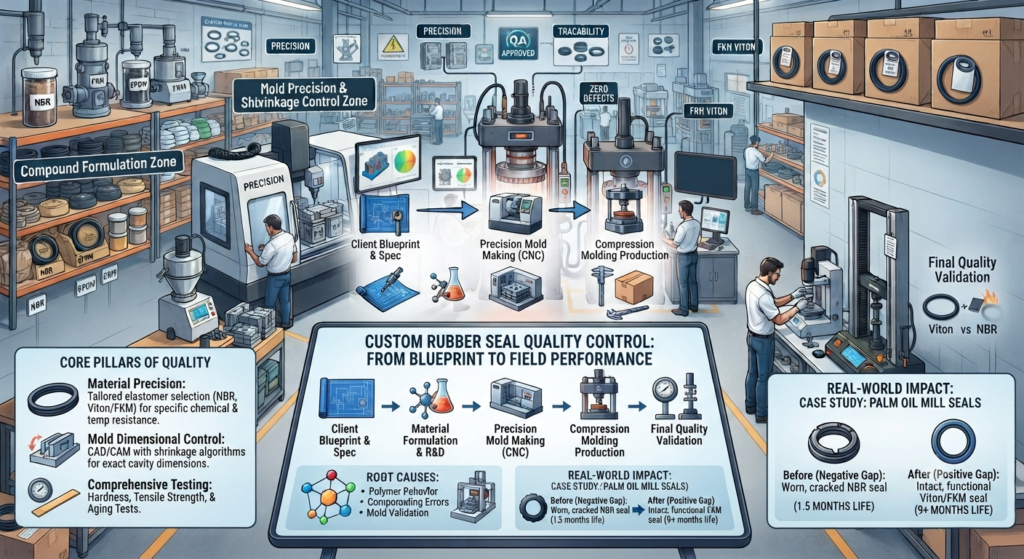
1. Compound Formulation Optimization
The first and most fundamental step is ensuring that the chemical rubber formula matches the client’s machine operating environment.
- If a client orders components for high-temperature chemical industry pump machinery, using standard base materials like Natural Rubber (NR) or Styrene-Butadiene Rubber (SBR) will inevitably trigger a negative gap because the rubber will quickly melt or degrade.
- Manufacturers must transition to high-performance elastomers such as FKM (Viton) for extreme chemical and temperature resistance, or HNBR for high abrasion and heavy oil resistance. Proper formulation ensures physical durability directly experienced by the client.
2. Mold Precision and Shrinkage Control
One of the biggest challenges in manufacturing customized rubber spare parts is dimensional shrinkage as the rubber cools down upon exiting the mold.
- Manufacturers must utilize computer-aided design (CAD/CAM) software equipped with specific shrinkage ratio calculation algorithms for each type of rubber compound.
- Molding creation via high-precision CNC machines ensures cavity designs account for shrinkage, yielding final products accurate down to the micrometer level matching client drawings.
3. Rigorous Internal Quality Testing
Before shipment, products should not rely solely on visual inspection. Manufacturers must enforce strict Quality Assurance (QA) through internal laboratory testing, including:
- Hardness Test: Utilizing a Shore A durometer to verify that rubber hardness matches client machine load specifications.
- Tensile Strength & Elongation Test: Testing tensile limits and elasticity so the rubber resists tearing under high-cycle operations.
- Aging & Immersion Test: Submerging rubber samples in chemicals or exposing them to high temperatures in test chambers to verify durability prior to field deployment.
4. Client Education and Collaboration
Gaps often stem from miscommunications in interpreting specifications or insufficient data regarding actual client plant operating conditions. Building interactive communication—such as involving the plant’s engineering team in early Design for Manufacturability (DFM) discussions—helps align expectations with realistic technical material boundaries.
In-Depth Case Study: Transformation from a Negative to a Positive Gap
As a real-world illustration, consider the implementation at a customized rubber spare part manufacturing plant servicing a palm oil mill.
- Initial Condition (Negative Gap): A palm oil mill ordered specialized hydraulic seals for fruit bunch pressing machines. The client expected the seals to last at least 6 months under high pressure and hot palm oil exposure. In practice, however, the seals leaked after just 1.5 months, causing disappointment and major complaints.
- Root Cause Analysis: The plant’s engineering team discovered that the standard NBR base material lacked resistance against the combination of high temperatures and free fatty acids present in crude palm oil. Furthermore, mold dimensions were slightly off due to failing to account for thermal expansion factors.
- Corrective Actions (Gap Minimization):
- The plant reformulated the compound using FKM (Fluorocarbon), offering superior chemical resistance to palm fatty acids.
- Recalibrated CNC molds to ensure precise dimensions without loose tolerances.
- Implemented pre-shipment fluid immersion testing in the laboratory.
- Final Result (Positive Gap): Following improvements, the new hydraulic seals operated successfully for over 9 months without a single leak. The client expressed high satisfaction as performance surpassed initial expectations, leading to an exclusive long-term supply contract.
Strategic Roles of Technology and Future Innovation in Rubber Manufacturing
With Industry 4.0 evolution, minimizing quality gaps no longer relies solely on manual, experience-based operator methods. Customized rubber spare part manufacturers are adopting advanced technologies to lock in precision end-to-end:
1. IoT Integration in Curing Machines (Smart Curing)
Deploying Internet of Things (IoT) sensors on compression and injection molding machines allows real-time monitoring of temperature, pressure, and curing time. Minor deviations trigger early warning systems or automatically halt processes to prevent defects.
2. AI-Based Polymer Flow Simulation (Mold Flow Analysis)
Before fabricating physical metal molds, plant engineers utilize advanced simulation software to predict how rubber fluid flows, fills cavities, and cools. This identifies and prevents air traps or low-density zones during the digital design phase.
3. Machine Vision Automated Visual Inspection
Manual inspection is prone to human visual fatigue when checking thousands of small parts daily. High-resolution camera systems backed by artificial intelligence detect micro-defects—such as surface pores, irregular corner cuts, or minor dimensional deviations—instantly with near 100% accuracy.
Risk Management and Financial Mitigation of Quality Gaps
Experiencing a negative gap is not merely a technical production issue, but a severe threat to a manufacturing company’s financial health. Every out-of-spec product triggering client complaints brings cascading impacts:
- Rework & Scrap Cost: High-value customized rubber compounds mixed with specialized chemicals go to waste, forcing the plant to restart production.
- Delay Penalties and Loss of Trust: Delivery delays from rework trigger contract penalties and damage long-term brand reputation among major industrial clients.
- Legal Risks and Machinery Damage Claims: If failed rubber spare parts (such as seals in heavy equipment or chemical systems) cause severe machinery damage, component makers face liability claims far exceeding component values.
Consequently, investing in gap prevention through multi-layered quality control systems functions as an asset and reputation protection investment rather than a cost center.
Conclusion
In customized rubber spare part manufacturing, business success is measured not by how fast products are molded, but by how reliably components perform under real field working pressures.
By deeply understanding client expectations versus reality perceptions, and proactively controlling critical variables like chemical formulation, mold precision, and laboratory testing, manufacturers effectively minimize negative gaps. When custom rubber spare parts endure and exceed operational expectations, plants successfully secure customer satisfaction while building resilient, trustworthy, and competitive industrial partnerships.