
Latest Articles
- Managing a Company Through the Philosophy of the Human Body: Synergy and Organic Functions in the Custom Rubber Workshop Industry

- Product Certification or Quality Evidence with Client and Third-Party Witness Testing: Which Takes Precedence for a Custom Rubber Spare Part Workshop?

- National Rubber Resilience and Material Innovation: The Heart of Modern Custom Rubber Component Reliability

- Happy Independence Day, Republic of Indonesia!
- Quality Gap Control: Precision Strategies and Risk Management in Customized Rubber Spare Part Manufacturing
Forging Resilience in the Gears of Time: The Courage to Decide and the Philosophy of Kaizen in the Rubber Industry
The rubber industry currently stands at a challenging crossroads. Beyond the pressures of climate change and sustainability regulations (such as the EUDR), industry players must navigate price volatility fueled by geopolitical dynamics, such as the tensions between Iran and the United States.
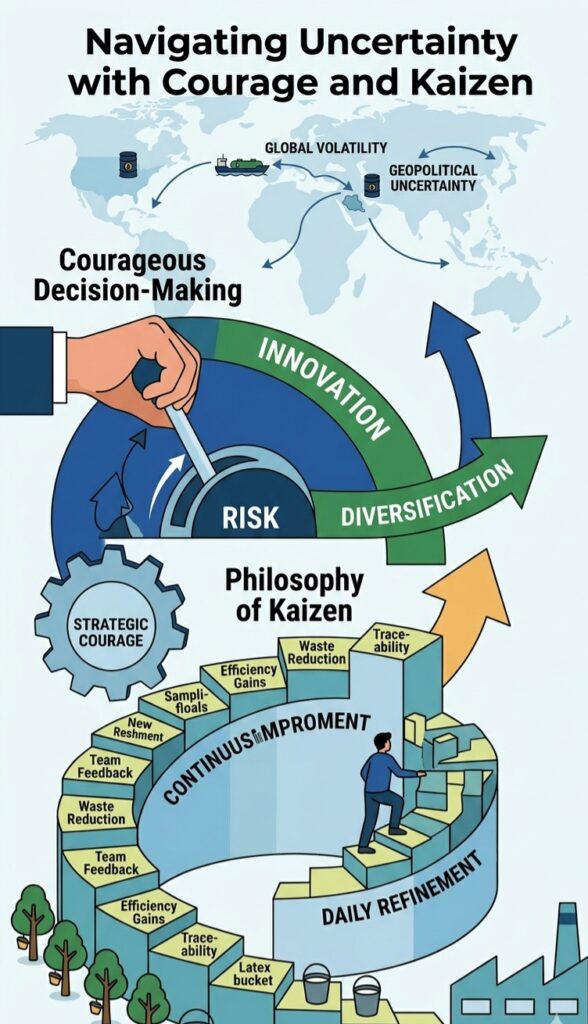
In a situation where crude oil prices—which directly impact synthetic rubber production costs—can surge at any moment due to conflict, companies can no longer rely on “business as usual.” It requires the courage to make decisions grounded in the philosophy of Kaizen—a continuous, step-by-step approach to improvement that is as consistent as it is disciplined.
Facing Volatility with a Kaizen Mindset
The Iran-US tensions often act as a catalyst for market speculation and rising logistics costs. Instead of being intimidated by macro-level factors beyond their control, the application of Kaizen principles offers intrinsic resilience for the industry:
- Micro-Efficiency for Macro-Stability: Kaizen teaches us to eliminate waste (muda) at every level of the process, from the plantation to the factory floor. By having the courage to make small, continuous improvements in energy consumption, chemical utilization, and labor efficiency, companies can create a “buffer” that keeps the business profitable even when raw material costs are pressured by external volatility.
- Adaptation Through Consistent Micro-Innovation: Amidst price uncertainty, the courage to innovate at a technical level—such as experimenting with higher-yielding rubber clones or cost-effective latex processing technology—is a tangible manifestation of Kaizen. These small, accumulated improvements create a competitive advantage that is not easily shaken by global price fluctuations.
- Supply Chain Transparency: Kaizen demands information openness to identify bottlenecks. By implementing transparent traceability systems, companies not only meet international regulatory requirements but also systematically improve workflows, making every link in the supply chain more robust in the face of global logistics disruptions.
The Courage of Sustainable Decision-Making
Integrating Kaizen into decision-making means that leaders must possess the courage to:
- Abandon the Search for “Quick Fixes”: Have the courage to reject shortcuts that harm the environment for short-term gain, choosing instead to build a system strong from the roots up.
- Empower the Team: Kaizen succeeds when everyone in the company—from the rubber tapper in the plantation to the manager in the plant—is given the authority to propose improvements. The bold decision to involve employees in problem-solving significantly boosts loyalty and productivity.
- Dare to Change During “Calm” Times: Do not wait for a geopolitical crisis to peak before taking action. True courage lies in making continuous improvements while market conditions are still favorable, ensuring the company has a resilient system in place before the storm arrives.
The Risk of Indecision
For industry players who choose to remain stagnant, the risks are stark: they will remain perpetual victims of global market sentiment. Without a spirit of continuous improvement, companies will fall into the trap of chronic inefficiency—a burden that will be felt far more painfully when oil prices rise and logistics costs soar due to geopolitical conflict.
Conclusion
The future of the rubber industry belongs to those who can combine strategic courage with a spirit of continuous improvement. With Kaizen, the shocks of geopolitical warfare or commodity price shifts are not the end; rather, they are reminders to constantly strengthen the business structure from within.
Leadership today is about the courage to refine oneself every single day, making the company more resilient, efficient, and ready for whatever the global market may hold.