
Latest Articles
- Managing a Company Through the Philosophy of the Human Body: Synergy and Organic Functions in the Custom Rubber Workshop Industry

- Product Certification or Quality Evidence with Client and Third-Party Witness Testing: Which Takes Precedence for a Custom Rubber Spare Part Workshop?

- National Rubber Resilience and Material Innovation: The Heart of Modern Custom Rubber Component Reliability

- Happy Independence Day, Republic of Indonesia!

- Quality Gap Control: Precision Strategies and Risk Management in Customized Rubber Spare Part Manufacturing
The Monozukuri Philosophy: Implementing Japanese-Style Lean Manufacturing Layouts for Custom Rubber Workshops
Introduction: More Than Just Manufacturing
In modern industrial discourse, the term Monozukuri is often misunderstood simply as “making things.” However, for Japanese manufacturing practitioners, Monozukuri is a profound philosophy that combines technical skill, spirit, and a dedication to achieving perfection. In the custom rubber sector, the challenges are far more complex than in mass production. Each order possesses different material characteristics, varying vulcanization durations, and extremely tight precision tolerances. An unorganized workshop will inevitably get trapped in a “labyrinth of waste.” This article provides an in-depth analysis of how a Lean Manufacturing-based layout transformation does not just change machine positions, but alters the entire pulse of company productivity through a holistic approach uniting people, space, utilities, and future technology.
Strategic Analysis: The 5W + 1H Framework in Workshop Transformation
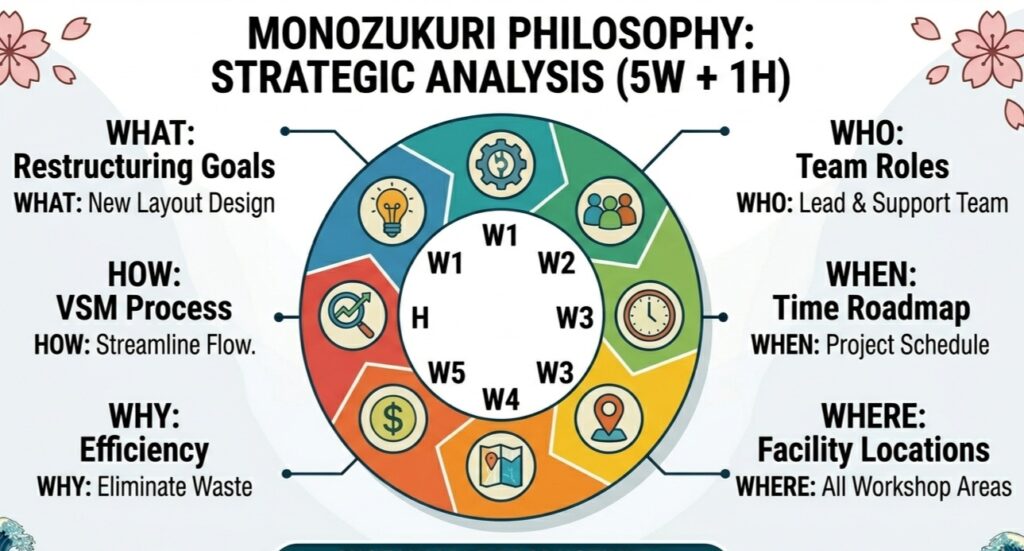
Before an organization moves a single machine, they must have a clear vision. The 5W + 1H framework serves as a strategic compass to ensure changes are purposeful and measurable:
- What: A total restructuring of the physical space and information flow within the workshop. This includes replacing linear production lines with flexible work cells and integrating visual management systems across the production floor.
- Who: A collective effort involving a cross-functional team—plant managers, maintenance technicians, production supervisors, and senior operators. Involving operators is vital as they possess “tacit knowledge” of daily floor dynamics.
- When: This is not an overnight project. It follows a roadmap starting with a one-month 5S audit, followed by machine reorganization during production lulls or major maintenance to avoid unplanned downtime.
- Where: Holistic implementation across all areas: from unloading sensitive chemicals and the mixing room to molding, finishing, Quality Control (QC), and shipping. Every inch of floor space must contribute value.
- Why: Efficiency and business sustainability. Without a precise layout, overhead costs swell due to wasted time and materials. The goal is to minimize the Seven Wastes, particularly unnecessary transportation and excess inventory.
- How: Utilizing Value Stream Mapping (VSM). By mapping the flow from raw materials to finished goods, the team identifies bottlenecks and redesigns the layout based on objective data.
1. The 5S Foundation: Architecture of Discipline and Technical Cleanliness
In Japan, 5S is the basic operating system for quality. In the rubber industry, where carbon black and chemical powders create a challenging environment, 5S is the first line of defense against product defects.
- Seiri (Sort): Managers must employ “Red Tagging.” Damaged molds or those not ordered for long periods must be removed. This frees up space for smoother material flow.
- Seiton (Set in Order): The “point of use” principle. Every tool is placed within the operator’s reach using shadow boards. This reduces tool-seeking time, which can consume 10-15% of productive hours.
- Seiso (Shine): Cleanliness is functional. Chemical dust migrating to finishing areas can cause adhesion failure in rubber-to-metal bonding. The layout ensures physical separation or directed air circulation.
- Seiketsu (Standardize): Creating consistent visual standards. Steam pipes are labeled for heat, cold water pipes in blue, and electrical lines are neatly arranged for quick anomaly detection.
- Shitsuke (Sustain): Building a culture of responsibility. Self-discipline is key so that the optimized layout does not return to chaos within weeks.
2. Cellular Manufacturing: The Power of U-Shape Layouts and Ergonomics
U-Shape Layouts are chosen for their ergonomics and the high flexibility required for custom rubber work.
- Multi-Process Handling: Operators no longer walk long distances. Standing in the center of the cell, they simply rotate to move items from mixing to preparation to the press. This maximizes value-added time.
- Instant Communication: Proximity allows for real-time feedback. If a rubber compound feels too hard, the press operator can immediately discuss it with the mixing operator, preventing defective batches.
- Workforce Flexibility: In peak times, three people can staff a cell. During slow periods, one multi-skilled worker can handle the entire sequence independently.
3. Technical Material Flow Analysis (VSM)
To achieve high efficiency, the layout must be data-driven. In a custom rubber workshop, we calculate:
- Cycle Time: The time to complete one process (e.g., 10 minutes of vulcanization).
- Lead Time: Total time from raw material entry to shipping.
The Japanese layout aims to synchronize these two so they are nearly identical through one-piece flow.
4. Mieruka and Andon Systems: Real-Time Problem Visualization
Mieruka is the concept of information transparency.
- Andon System: Three-colored indicator lights (green, yellow, red) above machines. Green means smooth operation, yellow means assistance needed, and red means the machine has stopped.
- Visual Marking: The floor is categorized with bold colors. Yellow for temporary storage, red for Reject (NG – No Good) products, and green for items that have passed QC.
5. Poka-Yoke: Building Error-Proofing Systems
Custom rubber is prone to human error due to the variety of recipes. Poka-Yoke is integrated into the layout to stop errors at the source.
- Interlock Systems: Presses will not start the cycle if the mold temperature is below target or safety doors are open.
- Smart Scale Integration: In the weighing area, digital scales are connected to instruction screens. The system blocks the process if chemical weights are outside the allowed tolerance (e.g., \pm 0.1 gram).
6. Utility and Energy Management in Layout
Strategic machine placement directly impacts operational costs:
- Steam & Hydraulic Lines: Presses are placed near the boiler to reduce heat loss.
- Compressed Air: Centralizing compressors prevents pressure drops.
- Electrical Load: Heavy machinery like Banbury mixers are placed near main distribution panels to minimize voltage fluctuations.
7. The PDCA Cycle: The Heart of Continuous Improvement (Kaizen)
- Plan: Analyze current value streams and calculate Takt Time (the pace needed to meet customer demand).
- Do: Execute the plan—move machinery and retrain operators.
- Check: After one month, collect empirical data on travel distance reduction and defect rates.
- Act: Perform “Fine Tuning” and lock in successful changes as the new Standard Operating Procedure (SOP).
8. Supermarket and Kanban Concepts
In the rubber industry, some stages require waiting (like compound cooling). The solution is the Supermarket system:
- Strategic Placement: Located between two main processes with limited, controlled stock.
- Kanban Cards: When the downstream process takes a rack, a Kanban card is sent upstream as a production order to replace it.
- Physical Limits: The area is designed to hold only a specific number of racks. If full, the upstream process must stop, preventing overproduction.
9. Smart Factory Integration
- Digital Andon: Physical lights are linked to a central dashboard for remote monitoring.
- IoT Sensors: Installed in storage zones to monitor temperature and humidity for sensitive raw polymers.
- RFID Tracking: Used on mold racks to drastically reduce setup times in large libraries.
10. Ergonomics, Karakuri, and Worker Dignity
Monozukuri treats workers as craftsmen, not just laborers.
- Karakuri Kaizen: Using simple mechanical aids powered by physics (gravity/springs) rather than motors—such as inclined sorting tables.
- Work Psychology: A bright, clean environment boosts morale. Pride in the workplace is the primary fuel for product quality.
11. Risk Mitigation, Safety (K3), and Green Layout
- Hazardous Material Management: Separate ventilation and bunding for chemical storage.
- Visual Evacuation Routes: Phosphorescent floor markings kept clear of obstructions.
- Mottainai (Anti-Waste): Re-grinding stations are placed near production to immediately process rubber flash, maintaining economic value and reducing landfill waste.
12. Change Management: Overcoming Human Resistance
Transitioning to cellular layouts often faces the hurdle of “We’ve done it this way for 10 years.”
- Education: Involving operators in planning desk heights and tool positions.
- Pilot Projects: Starting with one small “model cell.” When others see the increased comfort and productivity, the desire to change emerges organically from the bottom-up.
Conclusion: Transforming Toward the Future of Rubber Manufacturing
Implementing a Japanese-style custom rubber workshop layout is not just about aesthetics; it is about building a productivity ecosystem that is resilient, adaptive, and sustainable. By integrating the 5W + 1H framework and the PDCA cycle, a company transforms from a cluttered traditional workshop into a world-class manufacturing entity. The results are measurable: space savings of 30-40%, increased profitability by eliminating waste (Muda), and the agility to serve an increasingly demanding custom market.